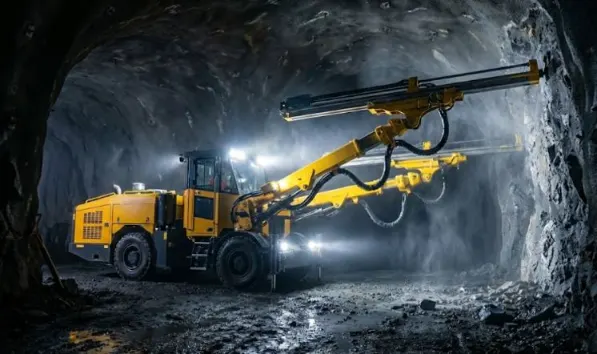
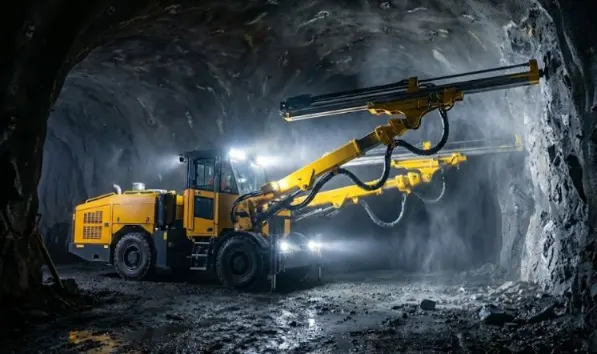
When you are planning a new decline or evaluating your development cycle for a medium-to-large tunnel, the equipment selection process often hits a snag. You look at the tunnel dimensions—let’s say a standard 5m x 5m haulage drift—and you have to make a choice. Do you stick with a nimble single-boom rig, or do you step up to a twin-boom machine?
The decision isn’t just about doubling the number of drill bits hitting the rock. It is about how the geometry of your heading interacts with the kinematics of the machine. In smaller headings (like 3m x 3m), a single boom is king. But once you cross into the 4m x 4m territory and push toward 8m x 6m, the physics of the operation change.
To get the advance rates you need without blowing the budget, you have to look at underground rock drilling rigs not just as hammers, but as coverage systems. It comes down to three specific factors: how much face area you can cover without moving the chassis, the density of the impact power, and the intelligence of the hydraulic control system.
Coverage Area & Positioning
The biggest thief of time in a drilling shift isn’t slow penetration; it is tramming and repositioning.
The Limitation of “Re-spotting”
If you put a single-boom rig in a 6-meter wide tunnel, the boom usually cannot reach the far corners of the face from a single central position. The operator has to drill the left side, retract the jacks, move the chassis over, set the jacks again, and drill the right side. Every time you move that chassis, you are not drilling. You are burning diesel and killing your cycle time.
The Twin-Boom Reach
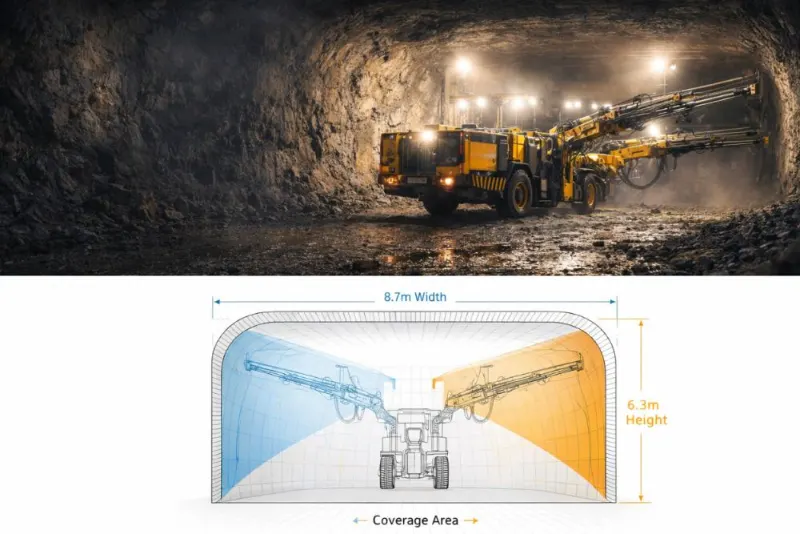
In contrast, a purpose-built twin-boom machine like the ZDFJ76A2 is designed specifically for these medium-to-large tunnels. It offers a maximum coverage area of up to 8.7 meters wide by 6.3 meters high. This capability changes the game. You park the machine once, set the four hydraulic jacks for stability, and you can drill the entire face pattern without moving the wheels again.
Also, consider the versatility required in these headings. You aren’t just drilling blast holes. You need to install ground support. The ZDT telescopic feed on this unit is designed for bolt hole drilling and cross cuttings even in limited spaces. Having a boom that can roll over ±180° and lift +65°/-30° means you can tackle roof bolting and face drilling with the same setup, keeping the advance rate steady.
Impact Power Density
Having two booms is great, but only if they have the muscle to back it up. A common issue with cheaper rigs is that they split the hydraulic flow, meaning when both booms are working hard, the pressure drops and penetration slows down.
The 24KW Standard
To drive advance rates in hard rock, you need high impact power. The ZDG550 hydraulic rock drill used on the ZONGDA jumbo delivers 24KW of impact power. That is a serious amount of energy transferring into the rock face. With an impact rate of 60-75 Hz, the drill bit isn’t just spinning; it is fracturing the rock at a frequency that clears chips fast.
Independent Hydraulics
The secret to keeping this power consistent lies in the pumps. You should look for a face drilling rig that doesn’t ask one pump to do too many jobs. The ZDFJ76A2 uses separate hydraulic pumps to control the anti-jamming, feeding, and rotary functions. This separation is crucial. It means that when the boom is crowding hard or the rotation torque maxes out at 980 Nm, it doesn’t rob power from the impact mechanism. The main variable pump is a Rexroth unit imported from Germany, ensuring that the flow matches the demand instantly.
The “Anti-Jamming” Efficiency
You can have the most powerful drill in the world, but if the steel gets stuck in a fault line, your shift is ruined. In broken ground, the difference between a good shift and a bad one is often how the machine handles jamming.
Rotation Pressure Controlled Feed (RPCF)
Manual intervention is too slow to save a drill string. That is why effective underground rock drilling rigs use automatic systems. The ZDFJ76A2 features a hydraulically controlled drilling system that incorporates an anti-jamming function known as Rotation Pressure Controlled Feed (RPCF).
Here is how it helps you: The system constantly monitors the rotation pressure. If the drill bit hits a clay seam or a void and the rotation resistance spikes, the system automatically stops the feed or pulls back slightly. It reacts faster than a human operator can blink. This prevents the rod from binding tight in the hole.
This feature saves you money in two ways. First, you aren’t spending 45 minutes wrestling a stuck rod out of the face. Second, it drastically lowers the consumption of drilling consumables. You break fewer shanks and coupling sleeves because the machine doesn’t force the steel when it shouldn’t.
Operator Synergy & Safety
Drilling a 45-hole pattern requires concentration. If the operator is fighting the machine or worrying about the roof, the holes end up crooked, and the blast pulls poorly.
The Office Underground
The environment inside the cab dictates the quality of work. You want a setup where the operator is protected under a firm steel FOPS-proofed roof. It provides maximum safety protection, which lets the operator focus on the alignment of the beams. The beams themselves are made of special aluminum profiles with stainless steel strips on the sliding surfaces, which keeps the movement smooth and predictable.
Automation that Helps
Small automated features reduce the hassle of setting up. For instance, dealing with trailing cables is a pain. This jumbo uses an automatic hydraulic-driven electric cable reel from Cavotec (Italy). It automatically retracts the cable when the equipment moves forward or backward. It sounds like a minor detail, but it saves labor and prevents the cable from getting run over, which is a major safety hazard.
Once the face is drilled and blasted, the cycle shifts to mucking. Whether you use trucks or underground mining locomotives for haulage, the pace is set right here at the face. If the drilling is accurate and on time, the trains and trucks run full. If the drilling is messy, everything downstream suffers.
Component Reliability
Finally, you have to consider what happens when something breaks. In a remote mine, you don’t want a “mystery box” component that can only be replaced by the OEM.
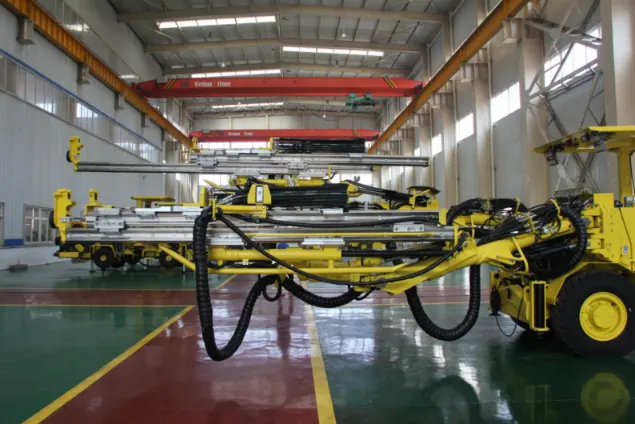
You want a machine built with parts your mechanics already know. The carrier on this jumbo is powered by a 5-cylinder Deutz diesel engine (F5L912W), a legend in the mining world for being air-cooled (or simple liquid cooled variants) and easy to fix. The drive train uses Dana 123 axles and a Clark 12000 transmission. These are the same components found on machines that cost twice as much.
The hydraulic system uses a simple mineral hydraulic oil and includes comprehensive filtration and water cooling. Indicators for low oil level and oil temperature are right there, guaranteeing the miners know the real conditions of the jumbo all the time. It is built to be fixed with a wrench, not a laptop.
Conclusion
When you step up to headings between 4x4m and 8x6m, the single-boom rig becomes a bottleneck. To keep your advance rates high, you need the coverage of a twin-boom setup combined with smart hydraulics that prevent downtime.
By choosing underground rock drilling rigs like the ZDFJ76A2, you get the 24KW impact power needed for hard rock, the RPCF technology to handle bad ground, and a component list (Deutz, Dana, Rexroth) that ensures you can always find spare parts. It’s a practical, high-performance solution that respects your operational budget.
Meet ZONGDA: Specialists in Underground Metal Mining
ZONGDA is a specialist manufacturer dedicated to underground metal mining solutions. Unlike generalist heavy equipment suppliers, ZONGDA focuses strictly on the unique demands of hard rock mining environments—specifically for Gold, Copper, Iron, and Lead-Zinc operations (note: they do not produce coal mining equipment).
Based in Qingdao, the company creates value by bridging the gap between premium Western engineering and cost-effective manufacturing. Their philosophy is “Simple & Robust.” They integrate global Tier-1 components—such as Deutz engines, Dana powertrains, and Rexroth hydraulics—into sturdy chassis designs that eliminate unnecessary electronic complexity.
Their product lineup covers the full extraction cycle, including Low Profile Dump Trucks (8-35 tons), LHD Loaders (0.6-6 m³), and Face Drilling Jumbos. This approach allows mines in remote locations to acquire high-performance fleets that are affordable to buy and easy to maintain, ensuring high availability without the premium price tag.
FAQ
Q1: What is the maximum tunnel size the ZDFJ76A2 can handle?
A: The machine is designed for medium to large tunnels. It has a maximum coverage area of up to 8.7 meters wide by 6.3 meters high. If your heading fits within those dimensions, this rig can drill the entire face from a single setup position.
Q2: How does the machine prevent drill rods from getting stuck?
A: It uses a system called Rotation Pressure Controlled Feed (RPCF). Basically, if the rock drill senses that the rotation pressure is getting too high—which happens right before a rod jams—it automatically stops pushing forward or pulls back a bit. It saves a lot of broken steel.
Q3: Are the parts hard to find if something breaks?
A: Not at all. The critical stuff is all standard global brands. The engine is Deutz, the axles are Dana, and the pumps are Rexroth. You can usually find parts for these at local distributors anywhere in the world, so you aren’t stuck waiting for a shipment from China.
Q4: Can this jumbo do anything besides drilling blast holes?
A: Yes, it is pretty versatile. The telescopic feed allows it to drill bolt holes for ground support, and the boom geometry allows for cross-cutting. It’s useful for drilling drift rods as well, so you don’t always need a separate bolter for every task.
Q5: Is it safe for the operator?
A: Safety is a big priority. The rig comes with a firm steel roof that is FOPS (Falling Object Protective Structure) certified. It also has separate hydraulic pumps and reliable alarm indicators for oil and water temperatures, so the operator always knows if the machine is running safely.