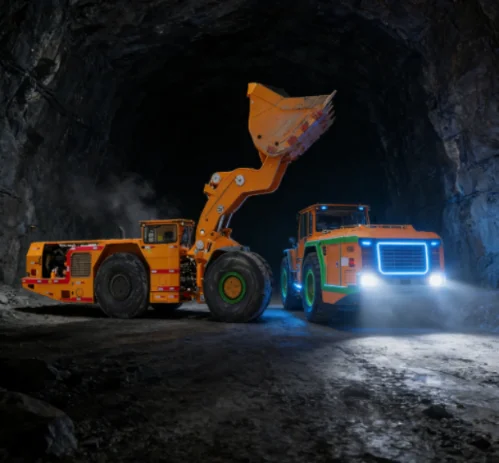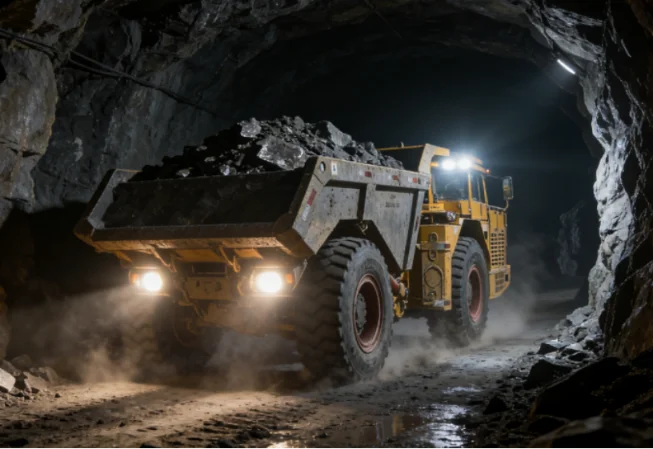
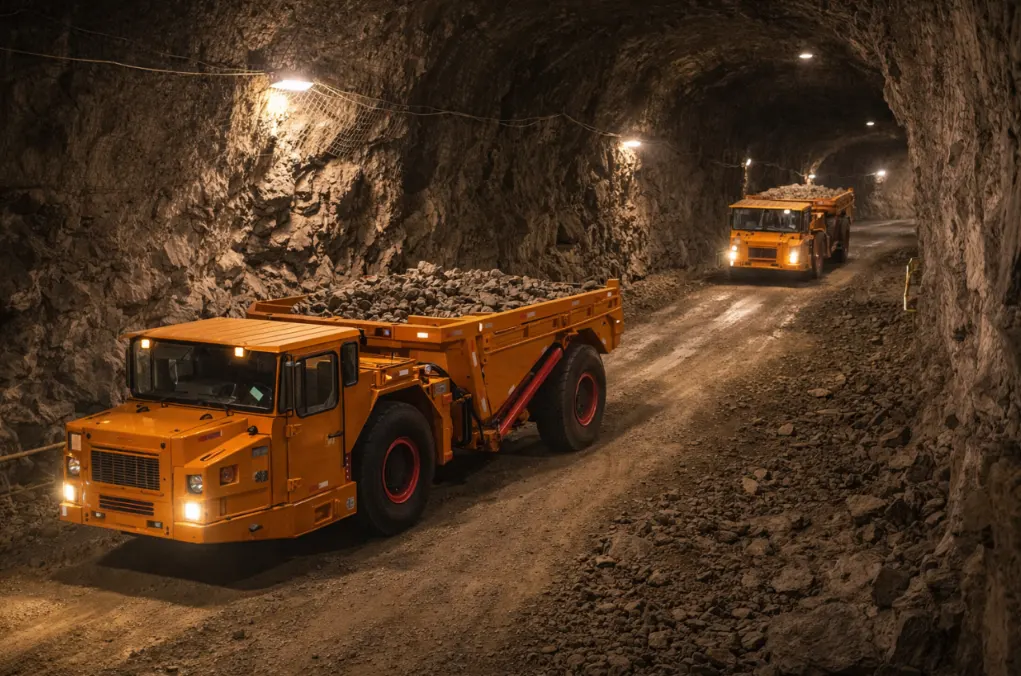
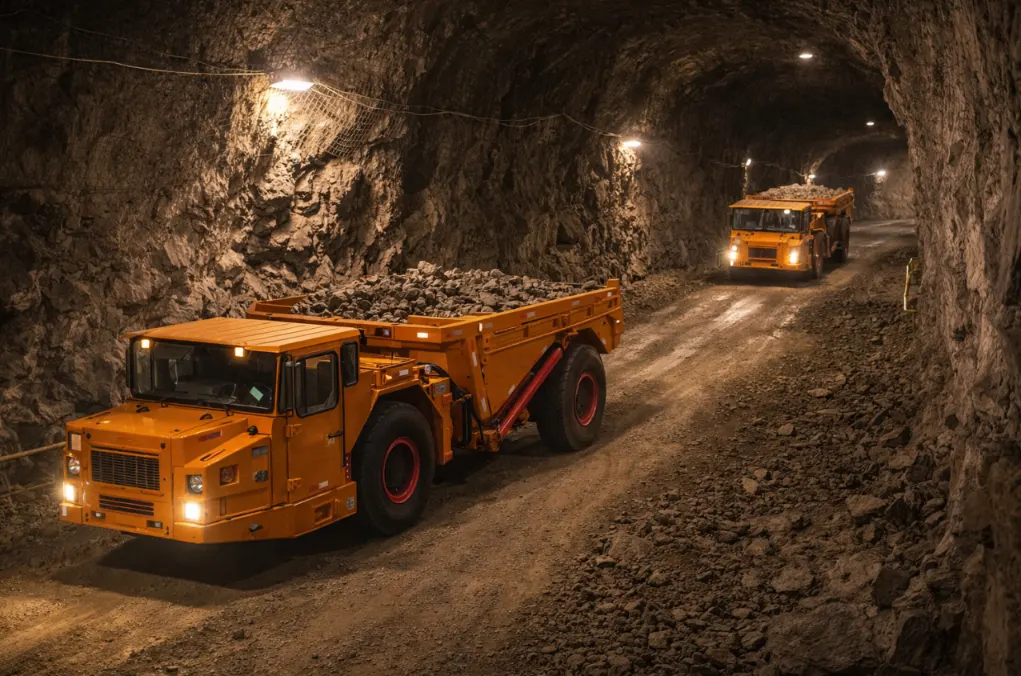
Underground haulage rarely breaks because a truck “cannot move.” It breaks because the cycle breaks. Loading waits, traffic stacks on ramps, dump points choke, and a small delay turns into a shift-wide slowdown. In that environment, underground mining trucks are not just vehicles. They are the moving link that keeps material transport underground aligned with the mine production cycle, from the face to the next transfer point—especially in confined underground space where routes, ventilation, and passing opportunities are limited.
Underground mining trucks also operate within a wider haulage workflow, where underground mining locomotives may be used on rail-based routes in certain mines. Understanding how these options fit into a system is often more useful than comparing a single spec line.
What Underground Mining Trucks Do in Underground Mines
So, what are underground mining trucks used for in real underground mine transport? Their job is simple in principle: move broken rock repeatedly from a loading point to a dumping or transfer location such as an ore pass, stockpile, crusher station, or designated dump bay. The complexity comes from the underground constraints that shape every part of the cycle: narrow drifts, tight turns, grades, heat, dust, and traffic behavior.
This is why the role of underground mining trucks is better described as “protecting flow” than “maximizing speed.” In most underground mining operations, the winning haulage strategy is the one that keeps the cycle stable across shifts, so downstream tasks do not inherit randomness from transport.
The Variables That Decide Whether Truck Haulage Works
If you want depth without drowning in specs, focus on the variables that actually control performance underground. In most truck-based systems, throughput is limited by a small set of factors:
- Haul distance: sets the baseline cycle time. Longer distance increases sensitivity to every delay.
- Ramp grade: adds sustained load and heat; small speed differences amplify queuing.
- Road condition: affects traction, braking behavior, and practical speed, not brochure speed.
- Load time and dump time: small increases here create queues faster than most people expect.
- Traffic density and passing points: underground congestion is structural, not “bad driving.”
When any one of these shifts, the truck cycle becomes less predictable. The queue does not disappear—it moves from the face to the ramp or to the dump point, and overall haulage efficiency underground drops even if every unit is “working.”
The Role of Underground Mining Trucks in Haulage Systems
An underground haulage system is a rhythm: load, travel loaded, dump, travel empty, repeat. Trucks sit in the middle of that rhythm as the capacity that connects production zones to transfer points. This is why mines should treat trucks as a workflow component, not a standalone purchase.
Truck-Based Haulage in Underground Mining
Truck-based underground haulage is commonly used when mines need flexibility across levels, variable headings, or shifting production zones. It supports loading and hauling operations underground that change as development advances. That flexibility is a planning advantage: routes can evolve, duties can shift, and the system can keep operating without redesigning fixed infrastructure.
In this context, terms like underground haul trucks emphasize the function: haulage capacity deployed where it stabilizes flow. The system succeeds when loading discipline, route constraints, and dumping logic stay aligned—not when one truck hits a peak speed in isolation.
How Trucks Fit Into an Underground Haulage System
Trucks fit best when handoffs are clear. A mine needs defined loading points, predictable travel routes, and dump/transfer rules that avoid “everyone arriving at once.” If loading is slow, trucks queue at the face. If haul roads degrade, travel time becomes noisy. If dumping is constrained, the queue shifts to the dump point. The symptom looks like “slow trucking,” but the cause is usually system imbalance.
This is also where mines sometimes use mixed transport, especially on fixed routes where rail-based haulage can be stable. In those cases, trucks may feed transfer points rather than running the entire distance.
Cycle Time Logic: Where Productivity Actually Disappears
A practical way to see underground haulage is to track cycle time as a sum of parts:
Cycle time = load + travel loaded + dump + travel empty + waiting
Most sites focus on the travel pieces first. Underground, the hidden killer is usually waiting. You can improve travel speed, but if waiting is 30–40% of the cycle due to congestion or dump-point limits, overall throughput barely improves. The biggest gains often come from reducing waiting through better coordination, clearer traffic rules, improved road condition, or smoother dumping discipline.
This is one reason “more trucks” can backfire. If the route is already constrained, adding units can increase traffic density and expand waiting faster than it increases effective haulage capacity.
Common Use Scenarios for Underground Mining Trucks
Production Level Haulage
Production haulage underground often involves repeated routes between stable loading points and established dumping locations. Here, success is defined by consistency: stable cycle time, predictable queue behavior, and a rhythm that holds across shifts. When underground mining trucks run in a stable cadence, the mine production cycle becomes easier to schedule and less vulnerable to small disruptions.
Decline and Ramp Haulage
Searches like “underground trucks mining” often reflect ramp concerns. Declines concentrate traffic into a narrow corridor and add sustained load. In ramp haulage, cycle time becomes sensitive to grade, passing opportunities, and speed variance between units. The deeper lesson is not “ramps are hard.” It is that ramps amplify system imbalance. If the dump point or loading point is slightly misaligned with route capacity, congestion appears quickly and persists.
Development and Expansion Phases
During development, routes and headings change often. Mines value flexibility, and trucks can absorb change without heavy infrastructure rework. In these phases, underground mining trucks act as the transport bridge that keeps material moving while the operation stabilizes layouts, schedules, and production zones.
Bottleneck Diagnostic Table for Underground Truck Haulage
Use the table below as a quick “symptom → likely cause → first check” tool. It adds real depth because it reflects how problems show up in daily operations.
| What you observe underground | Likely bottleneck | Why it happens | First thing to check |
|---|---|---|---|
| Trucks queue at the face | Loading constraint | Load time variability creates rapid queues | Loader availability, bucket/fill time, dispatch timing |
| Ramp congestion grows shift-wide | Route constraint | Passing points and speed variance amplify waiting | Passing bay spacing, grade hotspots, traffic rules |
| Waiting moves to dump/transfer point | Dump capacity limit | Dump time and cleanup delays cap throughput | Turnaround time, dump discipline, spill cleanup workflow |
| Cycle time becomes “noisy” day to day | Road condition | Traction and practical speed fluctuate | Road maintenance cadence, wet spots, surface integrity |
| Adding trucks does not raise output | System imbalance | Waiting increases faster than travel capacity | Where waiting occurs (face, ramp, dump), dispatch logic |
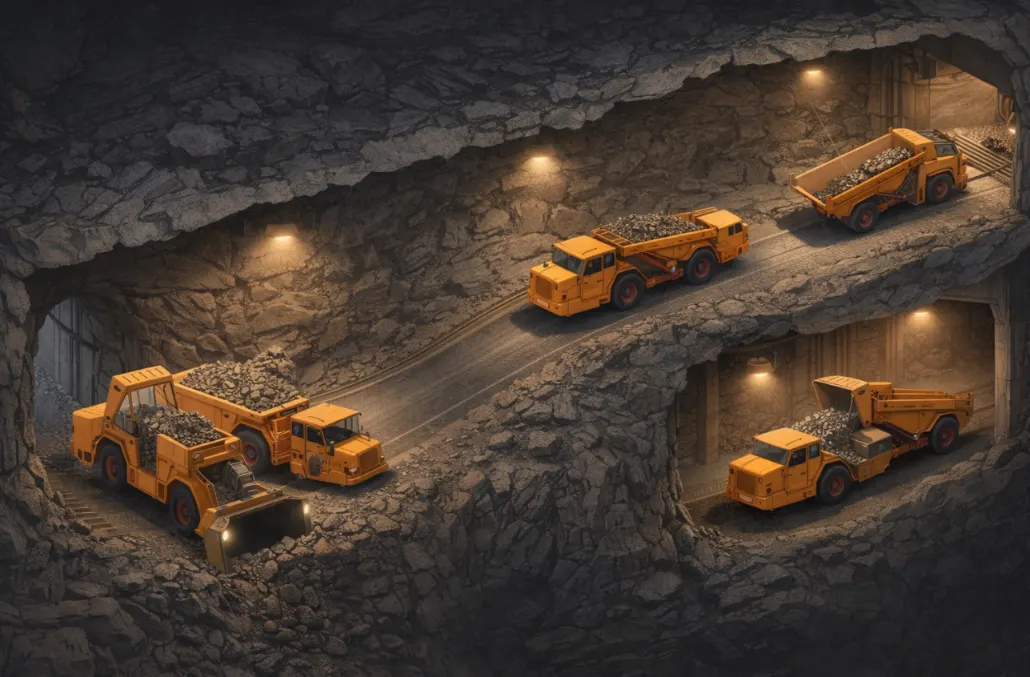
Why Underground Mining Trucks Are Different From Surface Trucks
Underground mine trucks are shaped by constraints, not comfort. Confined underground space limits turning, passing, and visibility. Ventilation limits influence heat management and how continuously the fleet can run. Road conditions and grades alter real duty cycles. The result is that underground transport equipment should be evaluated by fit and repeatability, not by headline speed or theoretical capacity.
This also explains why the best “truck strategy” is rarely only about trucks. It includes route design, traffic discipline, and a maintenance rhythm that protects uptime.
Impact on Productivity and Mine Planning
Haulage Efficiency Underground
Haulage efficiency underground is often a queue problem disguised as a vehicle problem. A small increase in cycle time can create a disproportionate increase in waiting when multiple faces feed the same route. The more constrained the system, the more sensitive it becomes. Mine planning should therefore treat haulage as a system: route capacity, dump capacity, traffic behavior, and loading rhythm all matter.
Workflow Continuity and Scheduling
The mine production cycle depends on continuity. When transport becomes unstable, face schedules slip and downstream tasks start absorbing randomness. To protect production flow, many sites standardize maintenance windows across key underground haulage equipment so transport bottlenecks do not cascade through the shift. This is not “maintenance talk” for its own sake; it is production control.
Conclusion
Underground mining trucks are central to modern underground mine transport because they keep material moving through constrained routes and protect the mine production cycle from stop-start disruption. Their value is measured less by peak speed and more by cycle stability—how consistently they support material transport underground, limit waiting, and sustain haulage efficiency underground across shifts. When you view trucks as part of a broader underground haulage system—and in some cases alongside rail-based options like underground mining locomotives—you can plan transport around real bottlenecks and build a haulage strategy that remains reliable as the mine evolves.
ZONGDA and Underground Haulage Perspective
ZONGDA focuses on underground mining equipment built for real haulage constraints—tight drifts, ramp traffic, ventilation limits, and long-duty cycles. In underground operations, transport is only as stable as the weakest link in the route. That is why ZONGDA emphasizes practical maneuverability, durability, and service-friendly layouts that help sites keep trucks running predictably across shifts. Whether your mine uses truck-only haulage or a mixed workflow that includes rail-based routes, the goal is the same: keep material transport underground aligned with the mine production cycle, from the face to the next transfer point.
FAQ
Q1: What are underground mining trucks used for in modern underground mines?
A: Underground mining trucks move broken rock from loading points to dumping or transfer locations such as ore passes, stockpiles, or crusher stations. Their role is to keep material transport underground stable so the mine production cycle can run smoothly across shifts.
Q2: Why do “underground trucks mining” routes often create bottlenecks on ramps?
A: Ramp haulage concentrates traffic into a narrow corridor and adds sustained load, heat buildup, and speed limits. Small disruptions—slow loading, poor road condition, or a constrained dump point—can quickly create queues, reducing haulage efficiency underground.
Q3: How do underground mining trucks fit into an underground haulage system with loaders or rail routes?
A: In many mines, trucks connect faces and loading areas to transfer points, while loaders handle short-distance loading and cleanup. Some sites also use rail-based transport on fixed routes. A well-designed underground haulage system defines handoff points and scheduling so each link supports, rather than blocks, the next step.
Q4: What is the key factor that improves haulage efficiency underground without adding more trucks?
A: Cycle stability. Improving road conditions, managing traffic flow, reducing waiting at dump points, and aligning loading and hauling operations often increases effective throughput more than simply adding units, especially in confined underground space.
Q5: What should planners look at when deciding where underground mine trucks add the most value?
A: Focus on haul distance, route geometry, congestion risk, and how transport delays affect downstream tasks. The best use of underground mine trucks is where they reduce cycle breaks and protect production continuity from the face to transfer locations.