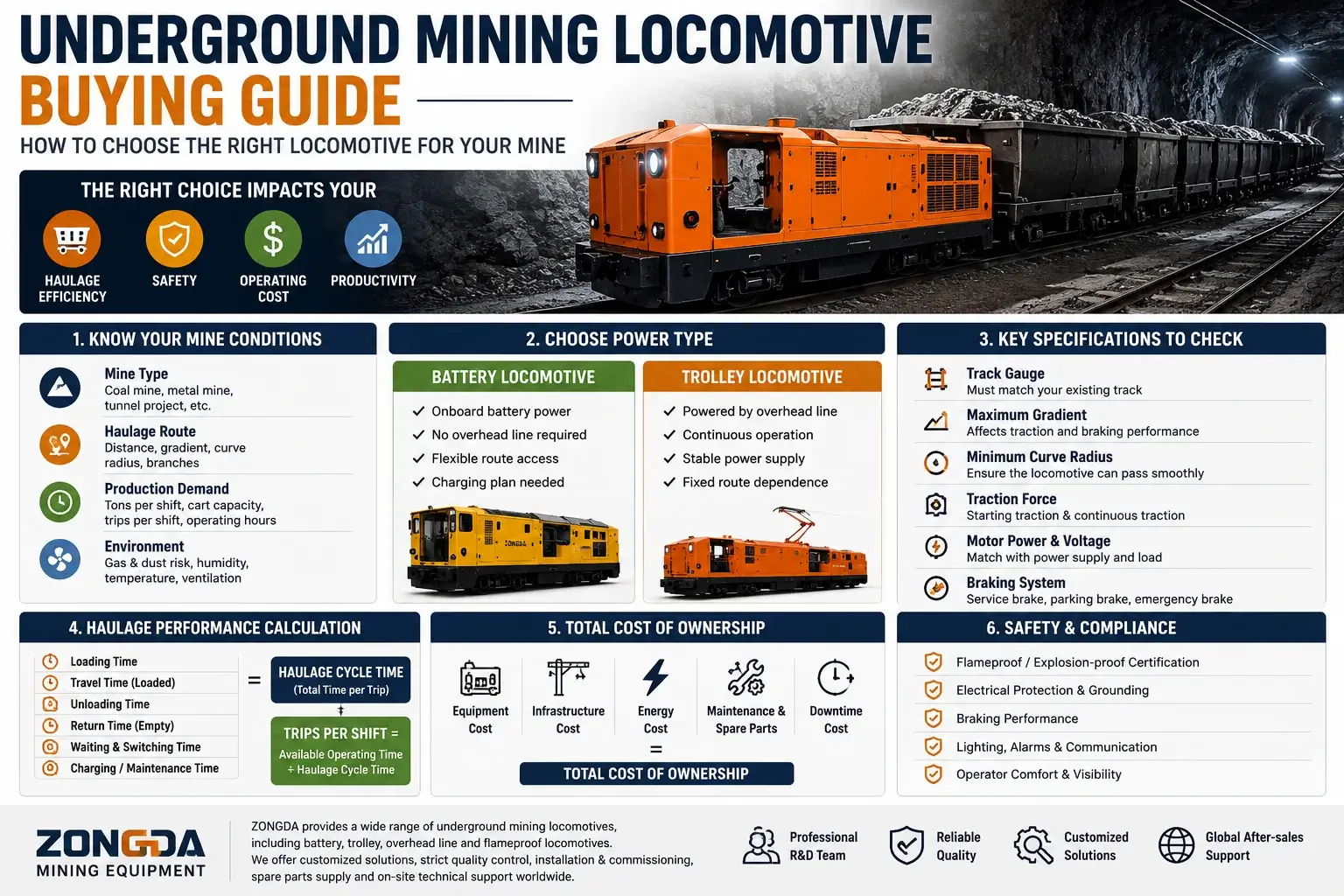
L'achat d'une locomotive minière souterraine ne se résume pas à choisir un tonnage sur catalogue. La machine doit être adaptée à votre voie, au poids de votre train, aux pentes, aux courbes, à la configuration de votre boîte de vitesses, à votre alimentation électrique et aux règles de sécurité. Une locomotive mal adaptée pourra certes fonctionner, mais elle risque de perdre du temps à chaque trajet ou d'avoir des difficultés à démarrer un train chargé.
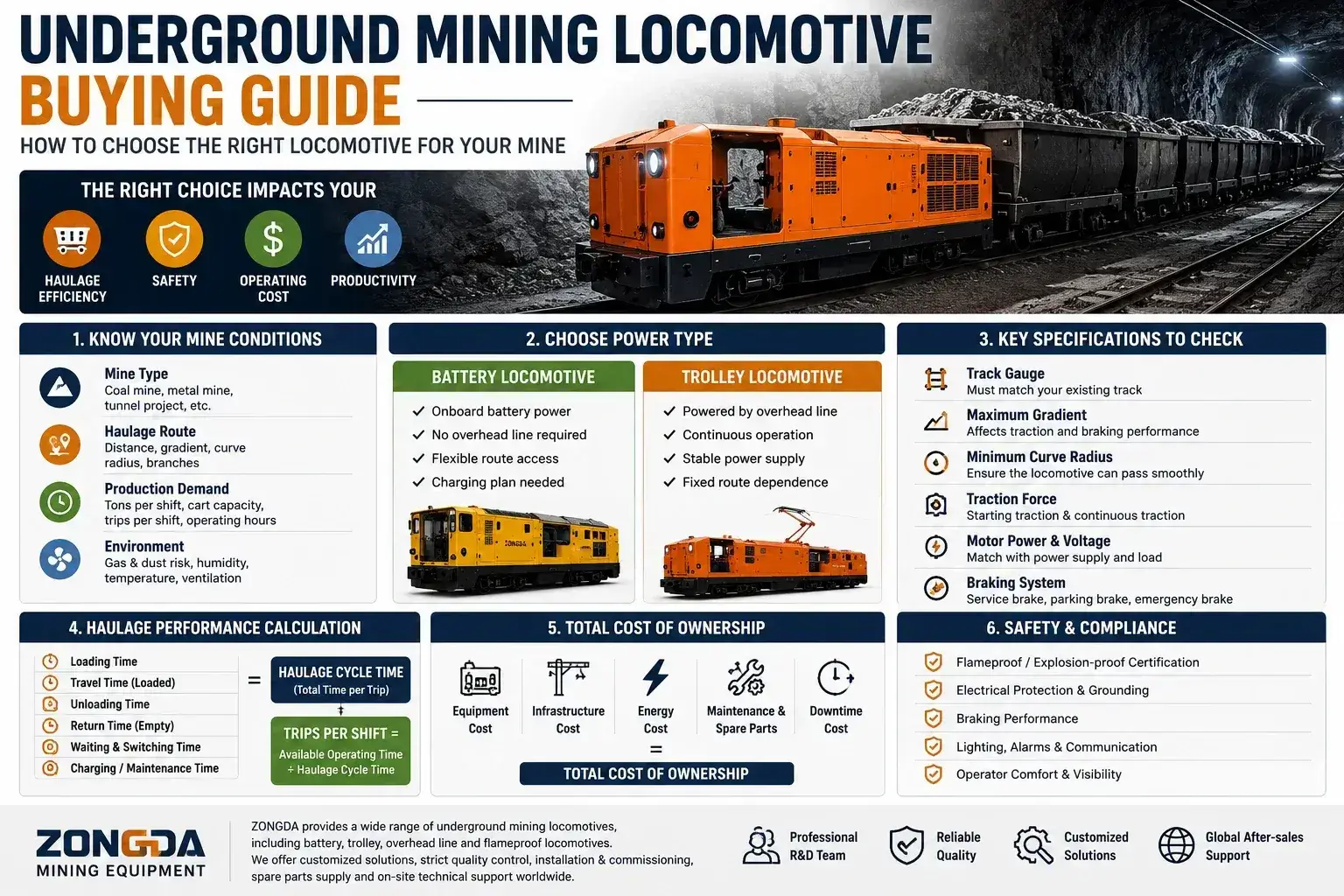
Ce guide d'achat de locomotives pour mines souterraines explique quelles données de chantier recueillir, quelles spécifications sont les plus importantes et quelles questions poser avant de demander un devis. L'objectif est simple : choisir une locomotive capable de déplacer la charge requise en toute sécurité et de manière répétée.
Que faut-il savoir avant de choisir une locomotive minière ?
Le choix commence par la tâche, pas par la machine. Avant de comparer la puissance du moteur ou la vitesse nominale, observez le comportement des matériaux lors d'un poste de travail normal. Notez les détails difficiles, comme un rail mouillé près d'un point de chargement ou un virage serré qui ralentit tous les trains.
Type de mine et conditions de travail
Précisez si la locomotive sera utilisée dans une mine de charbon, une mine de métaux, un tunnel ou tout autre site souterrain. Les travaux en milieu dangereux peuvent exiger un équipement électrique antidéflagrant et une certification locale. D'autres mines peuvent privilégier la distance de transport, la résistance à la corrosion, l'exposition à l'eau ou la ventilation.
La température, l'humidité, la poussière et l'eau peuvent également affecter les batteries, les connexions électriques, l'isolation et les pièces de freinage.
Route et tâches de production
Enregistrez la distance de transport aller simple, le temps de chargement et de déchargement, le nombre de trajets par quart de travail, les heures de travail et le poids chargé de chaque chariot.
Six wagonnets effectuant trois courts trajets ne génèrent pas la même charge de travail que douze wagonnets circulant quasiment sans interruption. L'écartement des voies peut être identique, mais les besoins en traction et en énergie diffèrent.
Quel type d'alimentation choisir ?
Le choix de l'alimentation électrique influe sur l'accès au réseau, l'infrastructure, les temps d'arrêt et les coûts à long terme. Un itinéraire variable privilégie souvent l'alimentation embarquée. Une ligne principale stable rend l'alimentation externe continue plus pratique.
Locomotives minières à batterie
Une locomotive à batterie embarque sa source d'énergie. Elle peut emprunter des embranchements sans ligne de contact continue, ce qui est pratique en cas de changement de direction ou d'itinéraire.
L'autonomie doit être calculée à partir du cycle de service réel. Le poids du train, la pente, la vitesse, l'état des rails, la température et l'âge de la batterie influent sur la durée de fonctionnement utile. A Locomotive électrique à batterie pour le transport souterrain Il convient de choisir le chargeur en tenant compte de son type de batterie, de sa plage de charge et d'une éventuelle batterie de rechange.
Locomotives minières à trolley
Une locomotive de trolleybus est alimentée par une caténaire. Elle peut fonctionner pendant de longues périodes sans recharge programmée, ce qui convient aux itinéraires fixes et au transport par équipes successives.
La ligne de contact fait partie intégrante du système. Les supports, câbles, sous-stations, collecteurs, accès pour inspection et prolongements de tracé engendrent des coûts supplémentaires. Cette option est optimale lorsque le réseau électrique est stable et que le personnel de maintenance peut en assurer l'entretien.
Comment choisir le tonnage de locomotive approprié ?
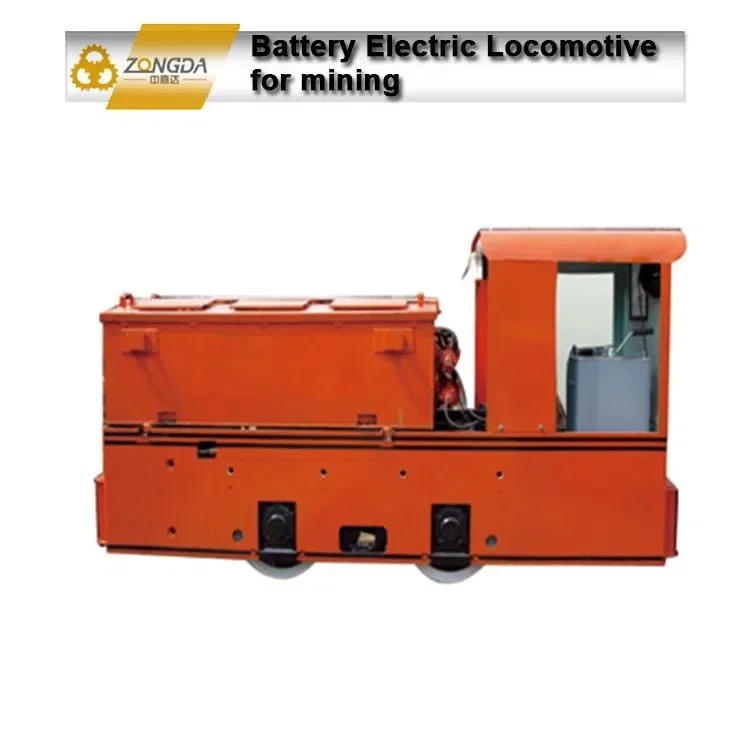
La puissance de traction de la locomotive est utile, mais elle ne décrit pas entièrement sa capacité de traction. La résistance du train, les conditions de démarrage, l'adhérence et la pente peuvent rapidement modifier le résultat.
Calculer le poids total du train
Additionnez le poids de la locomotive, le poids des wagons vides, la charge utile et le nombre de wagons. Utilisez le poids du train normal le plus lourd, et non la charge moyenne.
Précisez également si la locomotive doit démarrer en pente. Démarrer un train chargé sur une pente mouillée est beaucoup plus difficile que de le maintenir en mouvement sur une voie plate.
Vérifier la traction et l'adhérence
Comparez la force de traction nominale, la traction au démarrage, la traction continue et le poids de l'adhésif. Une puissance moteur plus élevée n'implique pas toujours une traction utile supérieure. Les roues peuvent patiner avant que le moteur n'atteigne sa pleine puissance.
La boue, l'eau, le pétrole et les fines particules de minerai réduisent l'adhérence. C'est un petit détail sur un dessin, mais un détail crucial à 2 heures du matin lorsqu'un train chargé refuse de redémarrer.
Quelles sont les spécifications les plus importantes ?
Une fiche technique peut contenir des dizaines de chiffres. Concentrez-vous d'abord sur les valeurs qui déterminent si la locomotive peut physiquement circuler sur votre itinéraire et accomplir la tâche requise.
Écartement des voies, pente et courbes
Indiquez l'écartement exact des voies en millimètres. Évitez les termes génériques tels que « voie étroite », car les mines peuvent utiliser des dimensions différentes sous cette appellation.
Identifiez la pente la plus raide et le rayon de courbure minimal. Vérifiez le point le plus critique, et non une moyenne. Une locomotive capable de franchir la ligne droite principale peut néanmoins se bloquer sur un aiguillage serré.
Vitesse, tension et freinage
La vitesse nominale influe sur le temps de trajet, mais les retards au chargement, les passages à niveau, l'état des voies et la distance de freinage peuvent limiter le débit réel. Plus rapide n'est pas toujours synonyme de meilleur en métro.
Vérifiez la tension du système et sa compatibilité avec le chargeur ou l'alimentation aérienne. Contrôlez les freins de service, de stationnement et d'urgence. Le freinage en descente avec un train chargé est un critère de sélection essentiel.
Un plus large gamme de locomotives minières souterraines peut vous aider à comparer les options de batterie, de chariot, de mine de charbon et antidéflagrantes une fois les données de l'itinéraire prêtes.
Comment calculer les performances du transport routier ?
La production journalière dépend du cycle de transport complet. La vitesse nominale seule ne permet pas de déterminer le tonnage transporté pendant un poste.
Construire un véritable temps de cycle
Additionnez les temps de chargement, de déplacement en charge, de déchargement, de retour à vide, de manœuvre, d'attente, d'inspection et de charge. Divisez ensuite le temps de fonctionnement disponible par le temps de cycle moyen.
Un retard de dix minutes répété six fois coûte une heure. De petites attentes répétées immobilisent souvent davantage la productivité qu'une panne unique et manifeste.
Sur un itinéraire stable avec des cycles fréquents, un locomotive à trolley pour le transport minier continu peut éviter les interruptions de facturation. Son intérêt dépend toutefois du réseau de lignes téléphoniques et du coût de sa maintenance.
Ajouter une marge de travail
Tenez compte de l'humidité des rails, du trafic, du vieillissement des batteries, de l'usure des roues et de l'entretien courant. Un calcul valable uniquement dans des conditions idéales ne constitue pas un plan d'achat pertinent.
Demandez des données de performance basées sur le poids et le trajet de votre train. Les estimations génériques du nombre de wagons peuvent être trompeuses car la charge utile, la pente et la résistance au roulement varient.
Combien coûte une locomotive minière souterraine ?
Le prix d'achat ne représente qu'une partie du coût total. Il faut également prendre en compte l'infrastructure, l'énergie, les composants de rechange, la main-d'œuvre, les pièces détachées et les temps d'arrêt.
Comparer les coûts complets du système
Pour l'alimentation par batterie, prévoir les chargeurs, l'espace de charge, les batteries de rechange, la manutention des batteries et leur remplacement futur. Pour l'alimentation par chariot, prévoir le fil de contact, les supports, la distribution électrique, les collecteurs, les câbles et les rallonges de ligne.
Calculez les coûts sur toute la durée de service prévue. Une machine bon marché peut s'avérer coûteuse si elle entraîne des déplacements annulés ou si elle nécessite des pièces dont la livraison prend des mois.
Quelles sont les caractéristiques de sécurité à vérifier ?
Les exigences de sécurité doivent figurer dans le cahier des charges avant le début de la production. Le freinage, la protection électrique, la visibilité et la certification doivent tous être adaptés à la mine et à l'utilisation prévue.
Protection contre le freinage et l'électricité
Vérifiez le frein de service, le frein de stationnement, le frein d'urgence, la protection des câbles, la protection contre les surintensités, les points d'isolement, les feux, les alarmes et les commandes de l'opérateur. Demandez comment le train chargé est testé sur la section de descente la plus raide.
Pour les travaux dangereux, un Locomotive ignifugée pour mines de charbon dangereuses Il reste nécessaire de procéder à une vérification au regard des règles et des certifications requises sur votre site. Le nom d'un produit ne constitue pas à lui seul une preuve d'acceptation du projet.
Quel type de soutien pouvez-vous attendre d'un fournisseur ?
Un bon équipement nécessite néanmoins une sélection rigoureuse, une inspection minutieuse, une mise en service appropriée et un service après-vente fiable. Renseignez-vous auprès du fournisseur sur la manière dont il vérifie les spécifications techniques avant la production et sur les modalités de livraison.
Avant et après l'accouchement
L'assistance avant-vente comprend le choix du modèle, le conseil technique et la confirmation des spécifications clés. Pendant la production, assurez-vous que le contrôle qualité et l'inspection soient effectués avant l'expédition.
Après la livraison, renseignez-vous sur l'installation, la mise en service, la formation, la fourniture de pièces détachées et l'assistance technique sur site. Exigez des réponses écrites. Les souvenirs sont souvent étonnamment flous une fois la machine sortie d'usine.
Un fournisseur conçu autour des systèmes miniers
Qingdao Zongda Machinery Co., Ltd. travaille sur des équipements d'exploration et d'exploitation minière souterraine plutôt que de considérer une locomotive comme un élément isolé.
Sa gamme officielle comprend les locomotives à batterie et à trolleybus, les équipements sans rails, la ventilation, le levage, l'exploration et les systèmes miniers associés. Cette plus grande diversité s'avère utile lorsqu'une décision relative au transport a également une incidence sur l'alimentation électrique, la ventilation, l'accès ou un agrandissement ultérieur.
L'entreprise indique disposer d'une équipe technique de plus de 30 spécialistes et ingénieurs miniers qui assurent le soutien en matière de recherche, de production, de contrôle de la qualité et de service après-vente.
Son processus de service comprend la sélection du modèle, la validation des spécifications, la gestion de la production, l'inspection avant livraison, l'installation, la mise en service, la fourniture de pièces détachées et l'assistance technique sur site. Il décrit également l'expérience acquise dans le cadre de contrats de projets miniers et de projets EPC (ingénierie, approvisionnement et construction). Pour vous, l'intérêt pratique réside dans l'intégration des spécifications de la locomotive à votre plan d'exploitation global.
FAQ (questions fréquentes)
Q1 : Comment choisir une locomotive minière souterraine ?
A : Commencez par l'écartement des voies, le poids du train, la pente maximale, le rayon de courbure minimal, la distance parcourue, le nombre de trajets par équipe et la puissance disponible. Comparez ensuite la traction, le freinage, l'autonomie et la certification.
Q2 : Quelle taille de locomotive minière vous faut-il ?
A : La taille appropriée dépend du poids total du train et de la résistance de la voie. Le tonnage de la locomotive seul ne suffit pas.
Q3 : Une locomotive à batterie ou une locomotive à trolley est-elle meilleure ?
A: L'alimentation par batterie est souvent plus adaptée aux itinéraires variables. L'alimentation par trolleybus est souvent plus adaptée aux itinéraires fixes avec de longues heures de service et une infrastructure aérienne existante.
Q4 : De quelles informations de suivi un fournisseur a-t-il besoin ?
A : Veuillez indiquer le gabarit exact, la pente la plus raide, le rayon de courbure le plus petit, la longueur du trajet, la configuration des aiguillages et l'état des rails.
Q5 : Combien coûte une locomotive minière ?
A : Le coût dépend du tonnage, du type de puissance, des exigences de traction, de l'écartement des voies, du freinage, de la configuration de sécurité, de l'infrastructure et de l'étendue du service.