
Choosing an underground mining vehicle often starts with one simple question: can it actually fit your tunnel? Payload, engine power, and price matter, but underground mine roadway size decides whether the vehicle can enter, turn, climb, stop, load, and leave safely.
If you work in a narrow non-coal mine, you need to check tunnel height, tunnel width, turning radius, road slope, ventilation, drainage, and ground conditions before you request a quotation.
Why Roadway Size Comes Before Payload?
A larger vehicle may look more productive on paper, but underground space is not forgiving. One tight curve, one low roof section, or one wet slope can make a good machine unsuitable. That is why underground mining vehicle selection should begin with real mine measurements, not only catalog numbers.
Check the Tightest Point, Not the Average Tunnel
You should measure the narrowest road section, the lowest roof area, the sharpest turning point, and the steepest loaded route. Average tunnel size can mislead you. A roadway may be 3.2 meters wide most of the time, but if one bend narrows to 2.8 meters, that section becomes the real limit.
Leave Room for People, Pipes, and Road Damage
A vehicle does not travel through an empty rectangle. There may be cables, ventilation ducts, water pipes, uneven road surfaces, loose stones, and workers walking nearby. A few extra centimeters can feel very small underground. In daily work, that small gap may decide whether the driver feels safe or tense all shift.
What Tunnel Height and Width Should You Check?
Tunnel size should be checked against the full working condition of the vehicle. You need more than static clearance. A loaded vehicle may move differently on rough ground, and the roof may not be even across the whole roadway.
Tunnel Height Affects Cab Safety
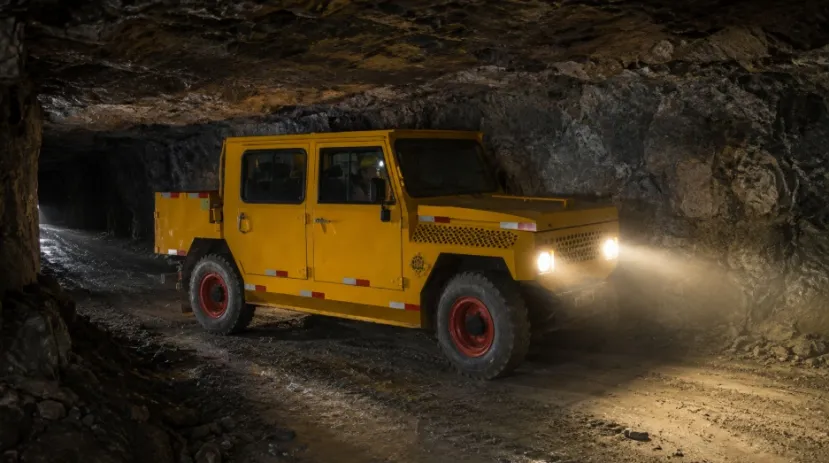
For a compact underground carrier, tunnel height affects the cab, driver visibility, roof clearance, and safe entry. The ZDFL-0.5 personnel and material carrier is designed for roadways with a cross-section of 2.5 meters height × 3 meters width and above, making it suitable for medium-section roadway operations in underground non-coal mines.
Tunnel Width Affects Passing and Loading
Tunnel width affects more than straight driving. It decides whether the vehicle can pass obstacles, park at a loading point, turn near an intersection, and allow workers to move safely. If your mine needs frequent tool delivery, repair support, or short-distance material transport, a compact underground utility vehicle can be more practical than a larger unit.
Why Is Turning Radius Often Overlooked?
Many buyers check length, width, and payload, then miss the turning condition. Underground, that mistake becomes visible fast. A poor turning match means repeated reversing, tire wear, wall contact, and slow transport.
Outside Turning Radius Is the Real Site Question
You should not only ask for the vehicle’s turning radius. You should ask whether your mine road has enough space for the outside turning path. The ZDFL-0.5 requires a minimum outside turning radius ≥6 meters, and the machine parameter lists a turning radius of 8400 mm. This is a key checkpoint before buying an underground personnel and material carrier.
Intersections Need Extra Attention
Measure crosscuts, ramp entrances, loading bays, and maintenance areas. These are the places where vehicles turn under pressure. A driver carrying tools, spare parts, or workers should not need a three-point turn every few minutes. It wastes time and, honestly, it gets old very quickly.

Can the Vehicle Handle Your Road Slope?
Slope is not only about climbing. It also affects braking, traction, heat, fuel use, and the driver’s control when the carrier is loaded. A vehicle that feels fine on a flat test road may behave differently on a wet mine ramp.
Match Mine Gradient with Loaded Climbing Capacity
You should record the maximum road slope, slope length, surface condition, and whether the vehicle must climb while loaded. The ZDFL-0.5 is suitable for roadways with road slope ≤14°, and its maximum heavy-load climbing capacity is also listed as 14°. That makes it a practical 0.5-ton underground material carrier for mines with moderate gradients.
Braking Matters as Much as Power
Good climbing power is only half the story. Safe stopping matters more on the way down. The ZDFL-0.5 uses wet multi-disc hydraulic brakes and a parking brake system, while its mining-pattern cut-resistant pneumatic tires support better grip on mine road surfaces. These details matter on wet underground roadways.
How Do Ventilation, Drainage, and Ground Conditions Affect Selection?
Roadway size tells you whether the vehicle can fit. Site conditions tell you whether it can work day after day. Poor air, standing water, weak ground, and loose roof sections can shorten equipment life and raise safety risk.
Diesel Vehicles Need Good Ventilation
A diesel underground vehicle needs a workplace with good air movement. The ZDFL-0.5 product conditions specify good ventilation and drainage in the working place, with an ambient tunnel temperature from -5℃ to 40℃ and maximum relative humidity not more than 85% at 25℃.
Drainage and Ground Strength Cannot Be Ignored
If water stays on the road, braking distance changes. If the ground is soft, tires sink and traction drops. If the roof condition is poor, safe vehicle movement becomes harder. Before choosing an underground material carrier, you should check drainage, road firmness, turning zones, and regular maintenance points.
Where Does ZONGDA Fit in Practical Vehicle Selection?
When buyers compare underground mine equipment, the best supplier is not just the one with a product list. You need a team that can read site conditions and talk through roadway size, slope, transport demand, maintenance access, and delivery needs.
A Practical Supplier for Underground Mine Work
ZONGDA focuses on underground mining machinery, including trackless mining equipment, underground locomotives, ventilation systems, hoisting systems, and drainage systems. The company has more than 30 experienced mining experts and engineers, with teams covering research, production, quality control, and after-sales technical support.
Its work is shaped by practical mine conditions rather than showroom thinking. For buyers choosing a ZONGDA underground mining vehicle, this matters because a carrier must match the roadway, not just the brochure.
A Clear Fit for Small Daily Transport Tasks
The ZDFL-0.5 has a 0.5-ton rated load and 4-person passenger capacity. It suits personnel movement, small material delivery, tool transport, and maintenance support in underground non-coal mines. If your roadway is at least 2.5 meters high and 3 meters wide, with an outside turning radius of at least 6 meters and slope within 14°, it is worth serious evaluation.
Conclusion
Underground mine roadway size is the first filter in underground mining vehicle selection. Before comparing price, you should measure tunnel height, tunnel width, turning radius, road slope, ventilation, drainage, and ground conditions.
A compact underground personnel and material carrier such as the ZDFL-0.5 can fit mines that need flexible daily transport without using oversized equipment. The right vehicle should feel natural in your roadway. If it fights the tunnel every day, it is not the right choice.
FAQ
Q1: What tunnel size is needed for an underground personnel carrier?
A: The required tunnel size depends on vehicle height, width, turning space, loading area, and safety clearance. For the ZDFL-0.5, the suitable roadway cross-section is 2.5 meters height × 3 meters width and above.
Q2: Why is turning radius important for underground mining vehicles?
A: Turning radius affects how easily the vehicle moves through intersections, curves, and loading areas. Poor turning fit can cause repeated reversing, wall contact, and slower transport.
Q3: Can a 0.5-ton underground carrier carry both workers and materials?
A: Yes. A 0.5-ton underground carrier can support workers, tools, spare parts, maintenance supplies, and small material transport when the mine uses short-distance, high-frequency logistics.
Q4: What road slope can the ZDFL-0.5 handle?
A: The ZDFL-0.5 is suitable for roadways with road slope ≤14°, and its heavy-load climbing capacity is listed as 14°.
Q5: What data should you prepare before asking for a quotation?
A: You should prepare minimum tunnel height, minimum tunnel width, turning radius, maximum slope, road surface condition, drainage, ventilation, daily transport distance, payload demand, and passenger needs.